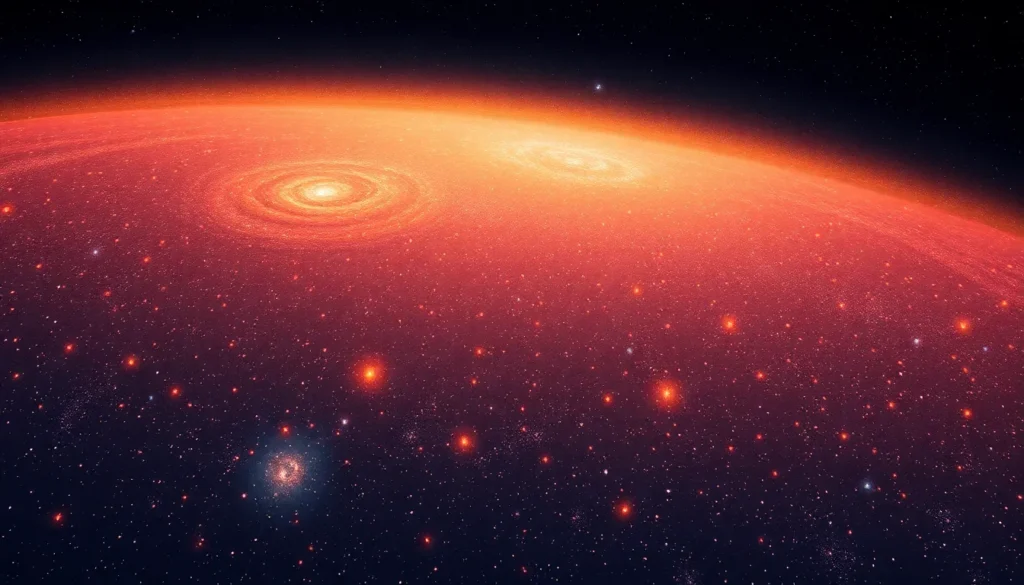
In the vast expanse of the universe, there’s a faint glow that’s more than just leftover pizza in the fridge. It’s the cosmic microwave background (CMB), the afterglow of the Big Bang itself. Imagine a cosmic version of a warm blanket, wrapping the universe in a soothing glow that tells the story of its birth. Scientists and stargazers alike are captivated by this relic from the past, unraveling secrets about the universe’s infancy and its evolution.
But don’t let the term “microwave” fool you. This isn’t about reheating leftovers; it’s about understanding the very fabric of reality. The CMB holds clues that could unlock mysteries of dark matter, dark energy, and even the fate of the universe. So grab your telescope and a cup of coffee, because diving into the world of the cosmic microwave background is a journey that promises to be as enlightening as it is entertaining.
Overview of Cosmic Microwave Background
The cosmic microwave background (CMB) is a relic radiation that fills the universe. It originated approximately 380,000 years after the Big Bang when protons and electrons combined to form neutral hydrogen atoms. This process allowed photons to travel freely, leading to the emergence of the CMB as the cooling universe expanded.
Detecting the CMB presents significant insights into the universe’s formation and evolution. Its nearly uniform distribution across the sky indicates the homogeneity of the early universe. Tiny fluctuations in the CMB temperature reflect density variations, which contributed to the large-scale structure of galaxies.
Observatories have captured detailed measurements of the CMB across multiple wavelengths. The Wilkinson Microwave Anisotropy Probe (WMAP) and the Planck satellite have provided crucial data. These observations have established a standard model for cosmology, detailing parameters like the universe’s age and the proportions of its constituents: ordinary matter, dark matter, and dark energy.
CMB research continues to shed light on fundamental questions of cosmology. Scientists explore aspects of inflation, the rapid expansion after the Big Bang, through CMB observations. Enhanced instrumentation and methodologies aim to detect primordial gravitational waves, giving insight into the earliest moments of the universe.
The significance of CMB extends beyond astronomy. It plays a vital role in understanding the universe’s fate. Analyzing its properties assists in unraveling mysteries regarding dark matter and dark energy, contributing to a more comprehensive understanding of cosmic evolution.
Historical Significance

Understanding the cosmic microwave background (CMB) reveals vital aspects of the universe’s history. This knowledge shapes modern cosmology and informs current theories about cosmic evolution.
The Big Bang Theory
The Big Bang Theory provides a foundational framework for discussing the universe’s origins. It posits that the universe began as a singularity around 13.8 billion years ago. An enormous explosion led to rapid expansion and cooling. As the universe cooled, particles formed, eventually leading to hydrogen atoms. These events set the stage for the formation of stars and galaxies. Cosmic microwave background radiation emerged as a key indicator of this early period. Observations of the CMB reinforce the Big Bang model, linking expansion rates and temperature fluctuations to current cosmological theories.
Discovery of CMB
The discovery of the CMB marks a pivotal moment in astrophysics. Arno Penzias and Robert Wilson inadvertently found it in 1965 while conducting radio astronomy experiments. Their observations revealed a uniform background radiation permeating the sky. This finding confirmed a major prediction of the Big Bang Theory. Detailed studies from missions like WMAP and Planck refined our understanding of the CMB’s characteristics. Mapping temperature fluctuations enhanced insights into the universe’s large-scale structure. Today, CMB research continues to inspire new questions about dark energy and cosmic inflation, highlighting its enduring significance in cosmology.
Characteristics of Cosmic Microwave Background
The cosmic microwave background (CMB) possesses distinct features that reveal much about the universe’s formation and evolution.
Temperature Anisotropies
Temperature anisotropies in the CMB represent minute fluctuations in temperature across the sky. These variations measure just a few microkelvins and indicate the density differences in the early universe. Such fluctuations played a pivotal role in the formation of galaxies. Data from missions like WMAP and Planck mapped these anisotropies, providing crucial insights into cosmic structure. Statistical analysis of these patterns has established the parameters of the standard model of cosmology. Understanding these temperature variations aids in refining theories about cosmic inflation and dark energy.
Polarization Patterns
Polarization patterns in the CMB arise from interactions between photons and free electrons during the early universe. These patterns reveal information about gravitational waves and the conditions present shortly after the Big Bang. Detecting polarization involves measuring tiny differences in the direction of light waves. Studies of the E-mode and B-mode polarization provide vital clues about cosmic inflation. Researchers utilize sophisticated instruments in observatories to gather and analyze this polarization data, deepening our comprehension of fundamental cosmological phenomena.
Importance in Cosmology
The cosmic microwave background (CMB) serves as a fundamental source of information in understanding the universe’s evolution. It provides insights into the formation of structures like galaxies.
Structure Formation
Structure formation stems from tiny temperature fluctuations in the CMB. These fluctuations represent density variations that eventually led to the grouping of matter. Gravitational forces amplified initial densities, allowing gas and dust to coalesce into stars and galaxies. Observations from the CMB help cosmologists study how these structures grew over billions of years. By analyzing temperature anisotropies, researchers can derive critical parameters related to the distribution of dark matter across the universe.
Understanding Dark Matter and Dark Energy
Understanding dark matter and dark energy relies heavily on CMB data. Dark matter affects the distribution of galaxies, while dark energy drives the universe’s accelerated expansion. Analyzing CMB polarization patterns reveals how matter distributes on large scales, enhancing knowledge of dark matter’s role in cosmic evolution. Furthermore, studying the CMB also sheds light on dark energy’s influence on the universe’s fate. Together, these insights contribute to a comprehensive model of cosmological dynamics, deepening our understanding of fundamental forces shaping the universe.
Future Research Directions
Future research on the cosmic microwave background (CMB) aims to uncover deeper insights into the universe’s structure and history. Expanding observational capabilities will enhance the ability to detect primordial gravitational waves, offering clues about the universe’s earliest moments. New telescopes, such as the Simons Observatory, will improve the precision of measurements related to CMB polarization, significantly impacting understanding cosmic inflation.
Investigating temperature anisotropies will continue to provide vital information regarding dark matter. Enhanced statistical analyses can help refine parameters regarding the distribution of galaxies. Researchers are also focusing on the role of CMB in understanding dark energy, which drives the universe’s accelerated expansion.
Upcoming satellite missions, like the NASA-led PICO (Primordial Inflation Explorer), aim to directly measure the imprint of gravitational waves on CMB polarization. New methods will emerge for examining the relationships between CMB observations and large-scale structure formations, providing frameworks for future cosmological models.
Collaborative efforts in the scientific community will foster interdisciplinary approaches, combining CMB studies with advancements in particle physics. This integration may lead to novel theories addressing outstanding questions in cosmology. Tracking variations in CMB data through time could unveil how cosmic events influenced structure formation over billions of years.
Documenting anomalies in current data can stimulate new research questions, pushing the boundaries of existing cosmological theories. The relentless pursuit of understanding the CMB will undoubtedly reveal more about the universe’s fate and fundamental forces shaping it.
The cosmic microwave background remains a cornerstone of modern cosmology. Its faint glow offers invaluable insights into the universe’s infancy and ongoing evolution. As researchers continue to analyze its intricacies, the CMB’s role in unraveling dark matter and dark energy becomes increasingly pivotal.
Future advancements in observational technology promise to enhance understanding of cosmic inflation and the universe’s overall structure. Collaborative efforts among scientists will likely lead to groundbreaking discoveries that challenge existing theories. The journey into the mysteries of the CMB not only enriches our comprehension of the cosmos but also inspires curiosity about humanity’s place within it.