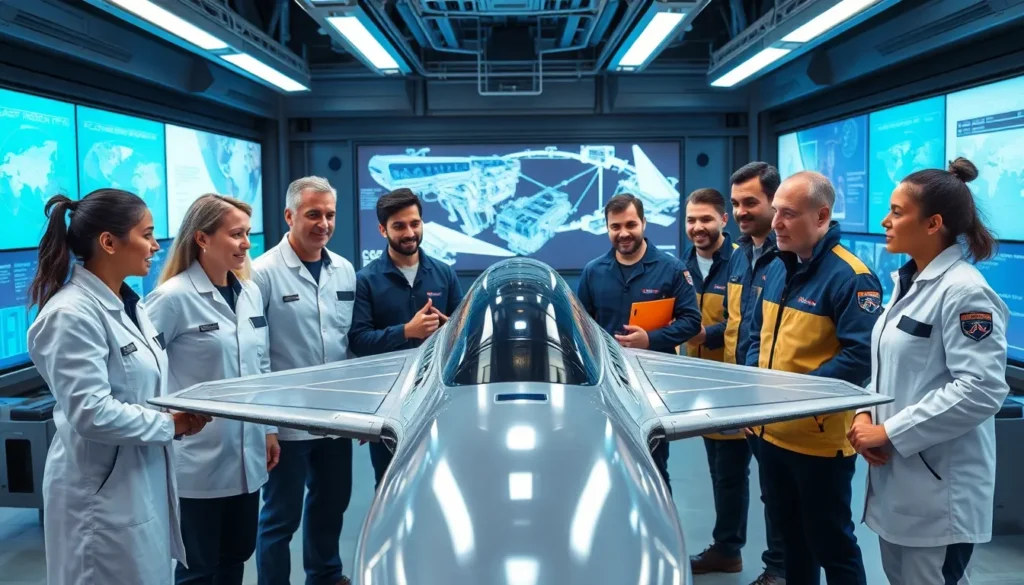
As humanity gazes up at the stars, dreams of interstellar adventures are no longer confined to the realm of science fiction. Future space travel technology is on the brink of transforming those dreams into reality. Imagine zipping across the cosmos faster than you can say “Houston, we have a problem.” With advancements in propulsion systems and innovative spacecraft designs, the final frontier is becoming more accessible than ever.
Future Space Travel Technology
Future space travel technology focuses on innovative propulsion systems, advanced materials, and sustainable life support systems. These advancements shape the potential for human exploration beyond Earth.
Propulsion Systems
- Ion propulsion: This technology uses electric fields to accelerate ions, significantly increasing efficiency compared to traditional chemical rockets. NASA’s Ion Propulsion System has successfully demonstrated these capabilities in deep space missions, suggesting a viable path for long-duration journeys.
- Nuclear thermal propulsion: Utilizing nuclear reactions to heat propellant, this method could reduce travel time to Mars by half. Companies like Blue Origin are investing in this technology to enhance the feasibility of crewed missions.
- Solar sails: These systems harness solar radiation for propulsion. Mission concepts, such as the Planetary Society’s LightSail, indicate how solar sailing may enable affordable travel throughout the solar system.
Spacecraft Designs
- Modular designs: Modular spacecraft can adapt to various mission profiles. Such designs allow for upgrades and repairs, ensuring longevity and flexibility.
- Reusable hardware: Companies like SpaceX demonstrate the effectiveness of reusable rockets. Recovering and refurbishing spacecraft reduces mission costs and enhances the frequency of launches.
- Autonomous systems: Implementing AI-driven navigation and decision-making systems may improve mission success rates. These technologies can minimize human error while optimizing resource use.
Life Support Systems
- Closed-loop systems: Recycling air and water onboard could support long-duration missions without resupply. NASA’s research into bioregenerative life support exemplifies this approach.
- Space agriculture: Growing food in space reduces dependency on Earth. Projects, like Veggie on the International Space Station, provide valuable insights into cultivating crops in microgravity.
Future space travel technology promises revolutionary advancements, making interstellar exploration not only conceivable but also practical for future generations.
Current Innovations
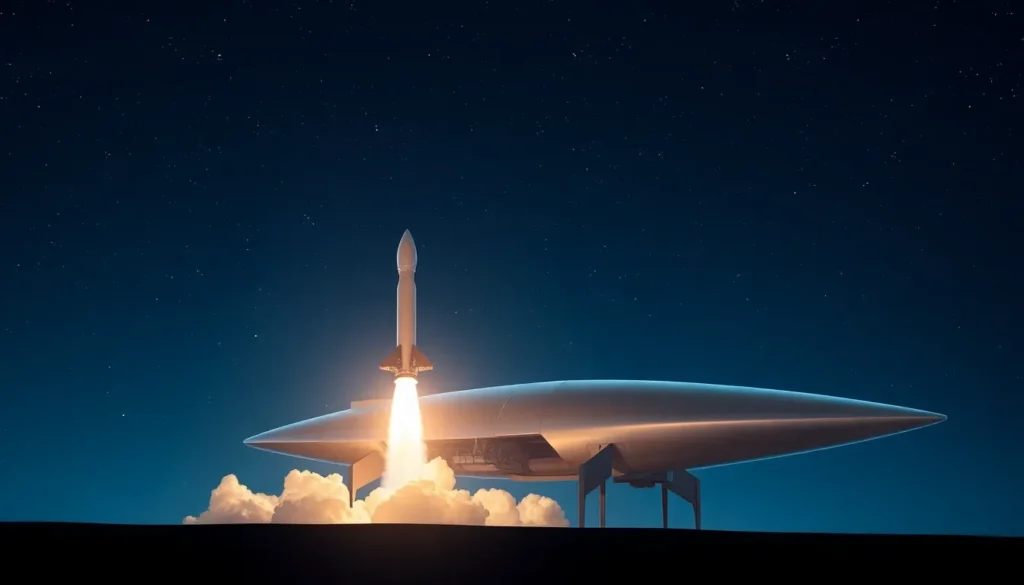
Innovations in space travel technology are rapidly transforming the landscape of human exploration beyond Earth. Current advancements focus on spacecraft design and propulsion systems.
Spacecraft Design
Innovations in spacecraft design emphasize modular architecture, which enhances adaptability for various missions. Reusable hardware significantly reduces costs and increases sustainability. Autonomous systems streamline navigation and decision-making, improving mission efficiency. Examples include SpaceX’s Crew Dragon, which features reusability for multiple flights, and NASA’s Orion spacecraft, designed for deep space exploration. These designs prioritize safety, reliability, and flexibility, enabling missions to diverse destinations in the solar system.
Propulsion Systems
Developments in propulsion systems play a crucial role in future space travel. Ion propulsion offers increased efficiency for long-term missions by using electrically charged particles. Nuclear thermal propulsion significantly cuts travel time to destinations like Mars, allowing for quicker human exploration. Solar sails, which harness solar radiation for propulsion, present new methods for extended missions. System advancements showcase the potential for rapid interplanetary travel, enabling missions that were once mere science fiction.
Emerging Technologies
Emerging technologies in space travel offer groundbreaking possibilities for exploring the cosmos. Innovations in propulsion systems and spacecraft designs are pivotal for advancing human exploration beyond Earth.
Ion Propulsion
Ion propulsion systems enhance spacecraft efficiency through the use of ionized gases. These systems generate thrust by accelerating ions, resulting in a continuous and high-efficiency propulsion method. Their ability to operate over long durations makes them particularly suitable for deep space missions. For instance, NASA’s Dawn spacecraft successfully utilized ion propulsion to explore the asteroid belt, proving its capability for extended travel. Ion propulsion significantly reduces the fuel requirements compared to traditional chemical rockets, promoting sustainment of long-distance space exploration.
Warp Drives
Warp drives represent an advanced theoretical approach to space travel, allowing for faster-than-light travel by warping spacetime. This technology relies on manipulating gravitational fields, creating a “bubble” that contracts space in front and expands it behind. Theoretical physicists, such as Miguel Alcubierre, propose models for warp drives that could open pathways to distant star systems in mere days or weeks. Although the technology remains primarily conceptual, ongoing research into exotic matter and energy sources may pave the way for practical implementation. Warp drives could revolutionize interstellar travel, making distant worlds more accessible for future exploration.
Space Tourism
Space tourism is rapidly gaining momentum, enabling civilians to experience space travel. Companies are developing commercial flights, enhancing accessibility to the cosmos.
Commercial Space Flights
Commercial space flights offer unique experiences, allowing non-professionals to travel beyond Earth’s atmosphere. Notable companies, like Blue Origin and Virgin Galactic, are leading this sector with suborbital flights. Blue Origin’s New Shepard and Virgin Galactic’s SpaceShipTwo provide brief experiences in microgravity, reaching altitudes above 50 miles. Futures plans include orbital and lunar tourism, targeting a broader audience and varying budgets.
Experience and Safety Measures
Experience in space tourism emphasizes both thrill and safety. Participants undergo pre-flight training to prepare for zero gravity and spacecraft procedures. Safety measures include rigorous testing of spacecraft, redundancy in critical systems, and continuous monitoring by mission control. Companies implement comprehensive health screenings for participants to ensure fitness for space travel. Such protocols enhance traveler confidence, making space tourism a viable option for adventurers.
Challenges Ahead
Future space travel technologies face significant challenges that must be addressed for successful implementation. Two major hurdles include cost and ethical considerations.
Cost and Funding
Funding space exploration poses substantial challenges. High costs for developing advanced technologies, constructing spacecraft, and launching missions require significant investment from governments and private sectors. Current estimates suggest that missions to Mars could exceed $100 billion. Securing sustained funding from diverse sources, including public-private partnerships and international collaborations, stands critical. Cost-effective solutions, like reusable rocket technologies, could alleviate financial pressures, yet the venture remains resource-intensive.
Ethical Considerations
Ethical concerns accompany advancements in space travel technology. Issues such as planetary protection, the potential for contamination, and the rights of future space settlers demand careful consideration. The Outer Space Treaty, established in 1967, addresses some legal frameworks but lacks comprehensive guidelines for new explorations. Ensuring responsible use of extraterrestrial resources and protecting celestial environments is vital for long-term sustainability. Engaging global dialogue among stakeholders helps create ethical standards that govern future missions and innovations in space exploration.
Future space travel technology is on the brink of transforming humanity’s relationship with the cosmos. As innovations in propulsion systems and spacecraft designs emerge, the dream of interstellar exploration becomes increasingly achievable. The advancements in reusable hardware and autonomous navigation are setting the stage for more efficient and safe missions.
Simultaneously, the growth of space tourism is opening the door for civilians to experience the wonders of space travel. Companies are paving the way for commercial flights that could soon lead to longer journeys beyond Earth.
While the challenges of cost and ethical considerations remain significant, ongoing research and collaboration will be crucial. With a focus on sustainable practices and responsible exploration, humanity stands poised to embark on an exciting new chapter in space travel. The future is bright and full of possibilities for those daring enough to reach for the stars.